|
Volume 10, Issue 2 – April 2026
|
 |
|
A Note from the Senior Director
Dear friends,
Spring always invites reflection. As campuses begin to bloom, and the school year moves toward its final stretch, it’s a natural moment to pause and consider what this year’s work has made possible. Across the country, you have continued to create space for learners to explore their options, submit applications, and envision futures that once may have felt out of reach. This steady commitment is what fuels our campaign year after year.
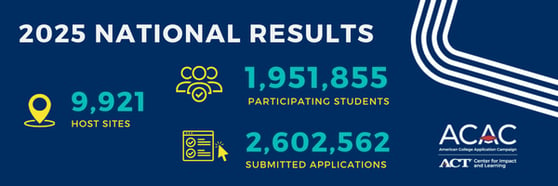
This month, we are proud to share the results of the 2025 American College Application Campaign. Thanks to your leadership and partnership, we reached record-breaking milestones:
-
1,951,855 seniors participated in college application events.
-
9,921 host sites held events.
-
2,602,562 applications were submitted nationwide.
Behind every number is a conversation, a completed form, a moment of encouragement, and a student who now sees their potential more clearly.
We're also honored to announce our 2025 School of Excellence winners. This recognition highlights schools that go above and beyond to ensure students have equitable access to postsecondary pathways. Their work reflects the very best of our mission: advancing education impact and access for all learners. We look forward to sharing more about their stories and celebrating the impact they’ve made in their communities.
As we reflect on this year’s accomplishments, we are also looking ahead. Later this month, ACAC leadership and state coordinators will come together for our annual convening — an opportunity to learn from one another, share strategies, and strengthen our collective efforts for the year to come. These conversations help ensure that our campaign continues to evolve, innovate, and respond to the needs of students and educators alike.
Thank you for the energy and care you bring to this work each day. Spring reminds us that growth takes time, intention, and partnership — and together, we are seeing that growth in communities across the nation.
|
|
With gratitude,
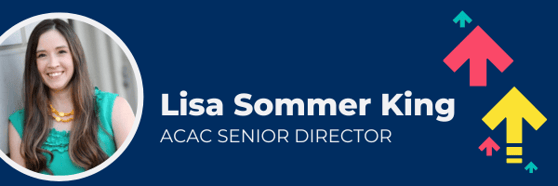
Lisa Sommer King, senior director
|
 |
 |
|
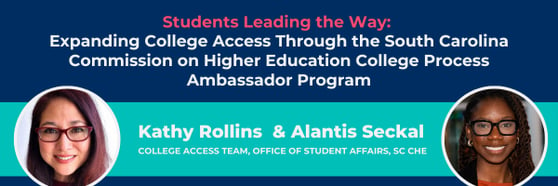
Students Leading the Way: Expanding College Access Through the South Carolina Commission on Higher Education College Process Ambassador Program
By: Kathy Rollins and Alantis Seckal, College Access Team, Office of Student Affairs, SC CHE
Building a Peer-to-Peer Pipeline
At the South Carolina Commission on Higher Education (SC CHE), staff have found that the most powerful voices in college access are often students themselves. This insight led to the College Process Ambassador Program, built around a simple but effective idea: peer-to-peer engagement can reach students in ways that adult-led messaging sometimes cannot.
The Vision: Meeting Seniors Where They Are
The original goal of the program was to connect directly with high school seniors across South Carolina during one of the most critical periods of their academic journey: the college application process. While the SC CHE College Access Team provides statewide guidance and resources, feedback from students and school partners revealed that traditional adult-led messaging, though accurate, was sometimes perceived as transactional or less personally relevant. Students reported greater comfort and engagement when hearing from peers navigating similar milestones in real time.
By integrating peer-led messaging into our strategy, we are strengthening institutional outreach, reinforcing accurate information through relatable student ambassadors who increase trust, engagement, and follow-through.
Each year, in April, before the new cohort starts off the next school year, high school counselors nominate outstanding seniors to serve as college process ambassadors. Interest in the program has grown significantly, with recent cohorts attracting more than 70 applications for just 10 available positions. The selection process is intentionally rigorous, ensuring ambassadors represent a diverse group of high-achieving, highly motivated students.
Many ambassadors rank near the top of their class, participate in multiple extracurricular activities, and in some cases balance full-time employment alongside their academic responsibilities.
Investing in Student Leaders and Their Futures
The College Process Ambassador Program is intentionally designed to be mutually beneficial, supporting both statewide college access efforts and the personal growth of participating students. Each ambassador receives a scholarship to their selected in-state college in recognition of their time and contributions, while also gaining valuable leadership experience that strengthens their college applications. In addition, students earn state-level recognition through their role with the South Carolina Commission on Higher Education as an SC CHE college process ambassador, an opportunity that highlights their commitment to service, leadership, and college access advocacy.
Starting in August and continuing throughout the academic year, ambassadors take on meaningful responsibilities, including:
- Submitting social media content and posts monthly, sharing their journey while navigating their college process
- Developing one-page reflections on their experience and offering feedback on how SC CHE can better support students statewide
- Attending a Commission Meeting to gain exposure to higher education policy and leadership
- Collaborating with fellow ambassadors to develop student-centered content
These activities not only amplify authentic student voices but also provide SC CHE with valuable, real-time insight into the needs and concerns of South Carolina students.
Learning and Evolving: Addressing Engagement Challenges
Like many student leadership initiatives, we observed a common pattern: engagement tended to decline after the holiday break. While ambassadors remained proud of their role, the intensity of senior-year responsibilities often shifted their focus away from program participation.
For the 2025–2026 cycle, SC CHE redesigned the program to maintain momentum and increase impact.
The Next Phase: Competition and Continuity
The updated model introduces two key innovations:
- A Competitive Challenge Structure
Ambassadors now participate in a structured, performance-based model designed to encourage consistent content submission and sustained engagement throughout the academic year. Participants earn points for completing defined activities and contributing approved content, with a transparent scoring system used to identify and recognize top performers. Ambassadors can monitor their standing in real time, allowing them to track progress, measure their contributions against program benchmarks, and stay motivated through healthy peer comparison.
This approach not only promotes accountability and consistency but also fosters collaboration, creativity, and a results-driven culture within the cohort.
- Expanding the Pipeline to Juniors
For the first time, high school juniors are included in the program. This shift allows SC CHE to:
- Reach students earlier in their college planning journey
- Extend peer influence to underclassmen
- Identify strong participants who can return the following year as senior ambassadors
This continuity benefits both students and the program. Returning ambassadors are already familiar to the audience, better prepared to create high-quality content, and more invested in the mission.
Why It Matters
The College Process Ambassador Program continues to demonstrate the value of student voice in college access work. By empowering motivated students, offering leadership opportunities, and continuously refining the program structure, SC CHE is building a sustainable peer-to-peer network that supports college-going culture across South Carolina.
As the program evolves, one principle remains constant: when students share their stories, other students listen and take the next step toward their future.
Measuring Impact Through Engagement
A key strength of the College Process Ambassador Program is its ability to produce measurable outcomes that demonstrate growing student engagement across the state.
Throughout the year, ambassadors participate in targeted engagement challenges, and during designated months, students compete to see whose content generates the highest levels of interaction, including likes, shares, comments, and new followers.
These efforts have produced significant growth across platforms. In the current year alone, our Instagram audience has increased by 30%, while our Facebook audience has grown by 75%. The continued growth across platforms reflects meaningful progress in connecting with South Carolina’s high school population and increasing awareness of college access resources.
Follow Us on Social:
Facebook
Instagram
|
|
Study: High School Students’ Views of AI in the College Application Process
By: Jeff Schiel, lead research scientist, ACT
A recent ACT study examined high school students’ perspectives on college readiness indicators and AI’s potential influence on the college application process. Research questions included the following:
- How do students view the importance of high school grades and other college readiness indicators?
- What do students think about the accuracy of grades, given that AI can be used to complete school assignments?
- Do students believe that using AI in the college application process gives applicants a significant advantage?
In this study, among other factors listed, high school students identified grades as the most important indicator of college readiness—more important than essays, admissions test scores, letters of recommendation, and supplemental materials. Students’ perspectives are supported by the National Association for College Admission Counseling, which considers grades as the most important factor in college admissions decisions.
Despite their importance, grades have imperfections (e.g., inflation, interpretation challenges). Moreover, grades can be especially affected by the use of AI in coursework, as students’ views suggest. For example, a majority of students (71%) in the study agreed that high school grades no longer accurately reflect student performance, because students can use AI to cheat.
The study also found that there are perceived fairness issues with the use of AI in the college application process. Notable percentages of students agreed that AI provides an unfair advantage for some students (70%), and students who use AI in this manner have a significant advantage over those who do not (69%).
Dive deeper into the study here.
|
|
College Signing Day: Put Your Stamp on How You Celebrate
May is just around the corner, and the month has traditionally served as a marker for College Signing or Decision Day celebrations around the country. Resources for school and college counselors, educators, and partners are available to download, including activity and event guides.
We encourage schools and communities to host their own Signing or Decision Day events to recognize students’ hard work and next steps — and share them online in videos or photos so we can all celebrate together!
Simple ideas can make a big impact. Things you can implement at your school:
- Create a signing wall
- Host a school-wide announcement moment
- Invite families to attend
- Offer photo opportunities with pennants or swag
- Highlight student plans on social media or in newsletters
Celebration builds momentum and reinforces that postsecondary journeys deserve recognition.
|
 |
|
National Internship Awareness Month
April is National Internship Awareness Month, which is a great opportunity to help students connect classroom learning to real-world careers. Even simple activities can spark exploration and build confidence.
To spark students’ curiosity and interest, consider:
-
Hosting a career or alumni panel with local professionals
-
Organizing job shadowing opportunities with community partners
-
Inviting employers to speak about internship pathways
-
Highlighting current student interns in announcements or on social media
By spotlighting hands-on learning, you help students explore pathways, grow their networks, and take meaningful steps toward their futures.
|
 |
|
My Journey 2026: Webinars
As students prepare for college, many questions arise. How do I make my application stand out? Am I eligible for financial assistance? How do I know what school is right for me?
The My Journey webinar series was designed to help students answer these questions and more. These free events give students the chance to hear directly from recent graduates and admissions experts about preparing for college and careers.
Here’s 2026’s My Journey lineup:
- On-Demand: What Colleges Really See: Turning High School Choices into Admissions Wins
- On-Demand: AI in College Admissions: What's Risky, What's Not, and What Colleges Think
- April 14: How to be "Uniquely You": Authenticity in College Admissions
- May 6: Navigating College Admissions: A Q&A for First-Gen and Immigrant Families
- July 15: Show Me the Money: Finding Scholarships for College
- August 19: College Admissions Q&A for Seniors: Your Ultimate Application Roadmap
- September 8: Study Smarter, Stress Less: Building the Skills That Lead to College Success
- October 6: Major Decisions: How to Pick the Path That's Right for You
- November 4: Ask an Admissions Counselor: Extracurriculars and College Apps
Register for events here.
|
 |
|
Common App: March Application Updates
Through March 1, 2026, 1,429,747 first-year applicants had submitted 9,423,621 applications—a 2% increase in applicants and a 5% rise in total applications compared to the same point last year. Students applied to an average of 6.59 colleges, up slightly from 6.41, continuing the steady upward trend in application volume and reach.
Key findings include:
- Growth in applicants and applications – Application activity continues to rise year over year.
- More applications per student – The average number of applications per applicant increased, signaling that students are broadening their options and institutions may face higher review volumes.
- Shifts in applicant demographics – Growth in applications from low- and middle-income communities and first-generation students highlights the ongoing expansion of access efforts across institutions.
- Geographic variation in application trends – While overall volume increased in the United States, the number of international applicants decreased compared to this time last season.
Read the full report here.
|
|
Summer Planning: Tips to Prevent Summer Melt After College Signing Day
As excitement builds around college signing decisions, it’s important to support students who haven’t yet applied or finalized their plans. A few proactive steps now can prevent summer melt later.
Encourage students to review remaining application deadlines, explore local open enrollment options, and connect with admissions representatives directly. Remind them to complete the FAFSA, check email regularly, and track important enrollment steps like orientation and housing forms.
A quick check-in before the school year ends can make all the difference in ensuring students stay on track and start the fall with confidence.
|
 |
|
ACT Summit
Join us July 13-15 in Nashville, Tennessee, for this year’s ACT Summit. Across 60 impactful sessions, the Summit provides the opportunity to share innovative ideas, best practices, and insights with leaders in K-12 education, higher education, and workforce development to address today’s most pressing challenges.
What’s new for this year:
- Choose how you learn best: Select between deep-dive presentations from experts and interactive roundtables where you engage with your peers. The choice is yours!
- Curated connections: Wrap up each day with facilitated conversations, designed to bring you together with colleagues, familiar and new, to talk about what you’ve learned and ways to apply it in your work.
- Getting Ready for the ACT Summit: Whether you're a first-time attendee or returning for another year, join our virtual orientation in June to get a preview of the ACT Summit experience. Hear from ACT staff and past participants as they walk through the agenda and share tips to help you make the most of your time at the Summit.
Register to attend here.
|
|
©2026 by ACT Education Corp. All rights reserved.
|
|